
CES 2026 Insights: Why we’re putting a face on AI in the Home and Beyond
I read an article just before CES about a young woman in Japan who married her AI chatbot, “Klaus” in an official real-life ceremony, complete with a dress, flowers and crying. I thought this was a bit bonkers until I got to Vegas and saw dozens of companies building AI companions for the home and office.
Over the years we’ve seen cute little robots and furry animatronic creatures that respond to human speech, visuals and touch, but they seemed to be novelties, super expensive and niche. Way back in 2019 we saw a Sony robot dog that was supposed to interact with you and cost more than $1K. Last year we loved Jennie from TomBot, a realistic lap dog built for folks suffering from dementia. But none of these compare to the flood of new AI companions on display at CES 2026.
I’d put these companions into three categories:
- Cute and furry, basically interactive toys
- Avatars in a bottle, these look more human in an anime-like style
- Business-like companions that basically turn your phone into a set of eyes and ears so you can better interact with your chatbot.


All of these connect to some kind of Large Language Model-based chatbot so you can bring your everyday companion to life right in your home. Yurina from Japan will be able to have her husband right with her on her desktop or nightstand.
I guess I shouldn’t be surprised by this considering I call ChatGPT “Chad” and my husband has a relationship with Alexa Plus. But what does it say about us humans that we feel the need to put a “face” to these AI chatbots? Why isn’t it enough to talk to them on our computers and phones? As much as we want to, we can’t make Chat GPT human but it looks like the industry is trying.
I don’t know where this is going, but after 10+ visits to CES, this is one trend that actually scares me.
Robots everywhere
Robotics and humanoid robots are not new either, but this year they definitely were taking over CES, mostly thanks to the rise of AI. Since we are in the smart home space, we are no stranger to robots, at least in the form of robot vacuums.
iRobot may be in Chapter 11 but the robot vacuum industry is marching along with new flagship models every six months or so, with every iteration trying to advance on some specific pain point.
Robot vacuums running over dog poop and toys created robots with computer vision to avoid obstacles. Robots getting stuck on thresholds created robots that can climb over them. This year robots climbing stairs were everywhere.

We actually have last year’s flagship Roborock with a robot arm that is designed to pick up shoes, socks, toys and other small objects. It’s a good start but needs more training cycles to really become useful.
Beyond robot vacuums, more and more companies are now also adding robot lawn mowers and pool cleaners. Those aren’t new either, but the previous models didn’t always have on-board GPS and/or computer vision which meant they were just creating and following a pattern. With new advances these are beginning to feel less like a specialty luxury technology and more of a practical helper worth buying.
There is obviously still a lot of room for growth in these outdoor robots. Not only were there easily twice as many robot lawn mowers at CES this year, 25-year old pool equipment company Fairland Group launched iGarden, a new brand of outdoor smart products, including swim jets, pool cleaners, pumps and lawn mowers.

Beyond these faceless helper robots, CES was full of humanoid robots designed to start taking on tasks around the house. The most popular one at the show, CLOID from LG, did some laundry in the company keynote but because of the crowds we never did get to see it operate in person on the show floor so we just had to watch the video like everyone else.
CLOID is designed to be a companion to your LG appliances to help realize their vision of a “Zero Labor Home.” He has “eyes” for computer vision, a torso with articulating arms to allow him to pick things up, and wheels to get around the house. He’s designed to integrate with LG’s ThinQ smart home ecosystem – which is interesting, since we now have three LG appliances running ThinQ, but I don’t see CLOID making an appearance at our house anytime soon.
Beyond CLOID there were all kinds of other humanoid robots at CES doing different things. SwitchBot had their own robot, the Onero H1, trying to pick up things off the couch and put them in the washing machine, with occasional success. We saw some others playing keyboards, others dancing, and others doing simple lifting or just hanging out in the booths.
The scariest robots we saw at the show were from Realbotix. The press release said that we wouldn’t believe how lifelike they were and they were right. They were unbelievable! There were three on display, all of them creepy. It was hard to tell how much they were interacting with the crowd, I noticed a guy who seemed to be controlling them from a console.

The Realbotix have real-looking skin and features and you can buy them as a bust (disembodied head), seated with upper body movement – so perhaps they could sit behind a desk and provide customer service, or a full-bodied robot. Prices start at $25K for the head, $95K for upper body, and $125K for the full robot, and their website claims you can place your order and get yours in as little as 12 weeks. I’m not sure who the target market is for these but I don’t think it’s for customer service.
Beyond the creepiness factor, there seems to be a real acceleration in this space due to AI large language models, with the sense that these are just another computer form factor that you could train to do tasks like ChatGPT or Gemini. But why would I spend $100K on something that I have to train to work in my home, very slowly? Maybe eccentric billionaires would buy them and then hire people to train them? But why? Just hire someone to come to your house to cook for you or do your laundry. I didn’t see any of these robots at CES doing anything that really felt like it would make a difference in my daily life. But it will be interesting to see how far they advance next year.
Longevity
Moving on to a more positive trend, healthcare at CES is bigger than ever. However, the buzzword is now longevity – increasing not just your lifespan but your healthspan, meaning you not just live longer, you remain healthy and active, inside and out.
The health products are now much more sophisticated than just smart watches and rings to track vitals, they are now integrating with other devices and using AI to take actions or deliver insights. For example, Urtopia, an e-bike company, was demonstrating how their e-bike could work with a new smart ring from their sister company to automatically adjust the resistance of your bike based on your heart rate and endurance, while Singapore-based Actxa was showing how their BGEM non-invasive technology can take data from Photoplethysmography sensors in smart watches and rings to evaluate and monitor blood glucose.

Connected home fitness devices are still there but there doesn’t seem to be as much innovation – the products looked just like more reasonably priced versions of the big names in the industry. What did feel more prominent were devices designed to manage and improve your mental health and wellbeing, from things like sleep and meditation aids to tactile devices like the Moonbird and Touchpoint solutions wearable devices.
One company who made a big splash this year was Echo Water. We happened upon them last year towards the end of the show and I brought home a first generation Echo Flask to test. The Echo Flask adds hydrogen to drinking water and the company claims that the hydrogen improves hydration, recovery, focus and sleep. This year their booth was double the size in a much more prominent location to support the launch of two new flagship products, a 40-oz stainless cup and an undercounter system that can give you fresh cold hydrogenated water anytime.
AARP’s booth seems to get larger every year and it’s always interesting to visit and talk to the different companies hosted at small tables inside. We were surprised to see Toto there since they used to have a much larger presence at CES. We are still waiting to see the smart toilet that was one of our favorites from virtual CES 2021.
When it comes to measurements, Withings is always announcing new innovations at CES and this year they showed their new Body Scan 2 – that they call the first science-backed longevity station. Stand on it and hold the bar and in 90 seconds, it measures 60 different biomarkers to help you get an assessment of things like heart pumping performance, metabolic efficiency, hypertension risk and more. It’s scheduled to ship in Q2 and will cost about $599 in the USA.
GLP-1-based medications for weight loss are a huge trend in the US and CES had plenty of panel discussions throughout the conference related to it. I didn’t see a lot of exhibitors in the space directly but I would expect more in 2027 if the trend continues. PWC estimates that 8 to 10 percent of Americans are taking GLP-1’s and 30 to 35 percent are interested.
For people managing Type-1 Diabetes, I was blown away by the Omnipod tiny insulin pump that simplifies life for people, providing 72-hours of continuous delivery without injections. I especially loved their collaboration with Marvel on Dyasonic, a high-school superhero with Type-1 diabetes.
We always see lots of massage chairs at CES and the booths are usually filled with people desperate to get off their feet and try them out. But the most impressive and luxurious booth I saw this time was the Ceragem Alive Intelligence Wellness Home. Ceragem is a Korean company that has been designing in-home wellness tech for 27 years and their CES booth was packed with beautiful leather-clad chairs, wellness pods, skincare systems and more. I’m not sure exactly what was actually available to buy but it all looked relaxing.
Smart Home
In the Smart Home, like everywhere else at CES, there are still plenty of companies exhibiting that seem to simply take whatever the product or service they are offering and slap “AI” on the label. It seems to have cooled down a bit from last year, and the smarter companies now are trying to describe the user benefits of what AI is bringing vs just saying “uses AI” or “AI enabled.”

We attended a great panel discussion before the show sponsored by Samsung, including a couple of panelists we’re very familiar with, Yoon Ho Choi of Samsung who runs the Home Connectivity Alliance and Michael Wolf of The Spoon. While Michael focuses on food tech and runs the food content at CES, he seems to have gone back to his smart home roots recently. I’m not sure if it’s comforting or not to see smart home trends circle back again ten years later. It either means we are experts in this space or just old.
The panelists pointed out that AI in the smart home is not new. The Nest Thermostat was built on AI, although they called it machine learning. Nest was successful because it used AI to save consumers money, by learning their patterns and adjusting their thermostats accordingly. With all the buzz of AI and so many things now connected, we hope more products will take advantage of it to bring actual benefits like the Nest.

Smart locks are one category that seems to be innovating and improving quickly. This year there were more facial recognition locks, including the first ever from Chamberlain MyQ, as well as new power systems to keep locks charged – a big pain point for consumers. Aqara announced the U400, their first lock to use UWB (ultra-wideband technology) to enable the user to use Apple HomeKey to unlock the door on approach. I love the idea of my front door unlocking when I’m walking up with my hands full.
Industry Standards
Matter as a smart home standard feels like a given now for most every smart home product. We were encouraged to see Matter support across lots of smart home products including Jasco Enbrighten in-wall outlets and switches.

In 2026 we are supposed to see the first Aliro-enabled smart locks that will allow users to share access credentials among different manufacturer’s locks. The Aqara U400 smart lock supports Matter and is also “Aliro-ready,” so it will be able to support other ways to access the lock in the future, starting with Samsung Wallet in Q1.
Z-Wave still has a big following, especially among the Home Assistant community, for its stability and ability to connect many devices. We are big fans of Zooz and are happy to see them continue to add Z-Wave long-range devices that can cover up to a mile and have much better battery life, great for sensors that monitor spaces in the farthest reaches of the home. The Z-Wave Alliance presence at CES is smaller than it used to be but we still see companies building new products on Z-Wave, such as the FireAvert electric and gas stove safety shut-off products.
For smart home control in general, there seems to be less and less emphasis on smart home hubs. Samsung still features their SmartThings platform and partnerships in their booth and Amazon shows connected devices in their Amazon showcase in the Venetian. Google used to have a huge stand-alone presence in the parking lot near the convention center, but they’ve abandoned that in favor of private meeting rooms and advertising like lighting up the Sphere to promote Android XR.
For more advanced controls than what these platforms offer, we still like Homey Pro that was acquired in 2024 by LG. We haven’t seen it fully absorbed into LG yet though it sounds like LG intends to have their ThinQ hub incorporate those features at some time in the future. While there are still a lot of smaller home hubs out there, it feels like most of the more sophisticated smart home users are increasingly using Home Assistant, with regular folks using many devices from one company together and perhaps linking things with Apple Home, Alexa or Google and using Matter to bridge different ecosystems when they’re available.
As for consortiums, it is interesting to see how their CES presence ebbs and flows as technology changes. The Home Connectivity Alliance is still active and makes announcements without a physical presence. The Wireless Power Consortium has had tremendous success with its Qi standard for wireless charging for phones and devices, but while the Ki kitchen power standard looks amazing and the booth gets bigger every year, it still seems a long way out before US consumers will be able to buy appliances that can run on a countertop without wires. I was surprised to find Kitchenry downstairs in Eureka Park, a startup building a wireless energy pad and a complete set of cordless appliances using a different technology.
In the health tech space, we thought it was interesting to see the National Sleep Foundation at the AARP booth, promoting their SleepTech standards for wearables, measurements and best practices in sleep solutions. As more and more devices claim to help you reclaim your lost sleep it seems like a good idea to look to experts like the NSF, who has been in the sleep health space since 1990.
Creators Everywhere
We’ve been creating videos at CES since 2017. In 2023 we started attending as Digital Content Creators when CTA started acknowledging the growth of people coming to CES to see and make content for YouTube, Instagram, TikTok, podcasts and more.
It’s only in the past couple of years where we’ve really seen CES acknowledge Content Creators on the same level as traditional TV, print and online media and in 2026, as a market in themselves. With more and more content moving to streaming, even the Oscars, it makes sense to treat this community accordingly.
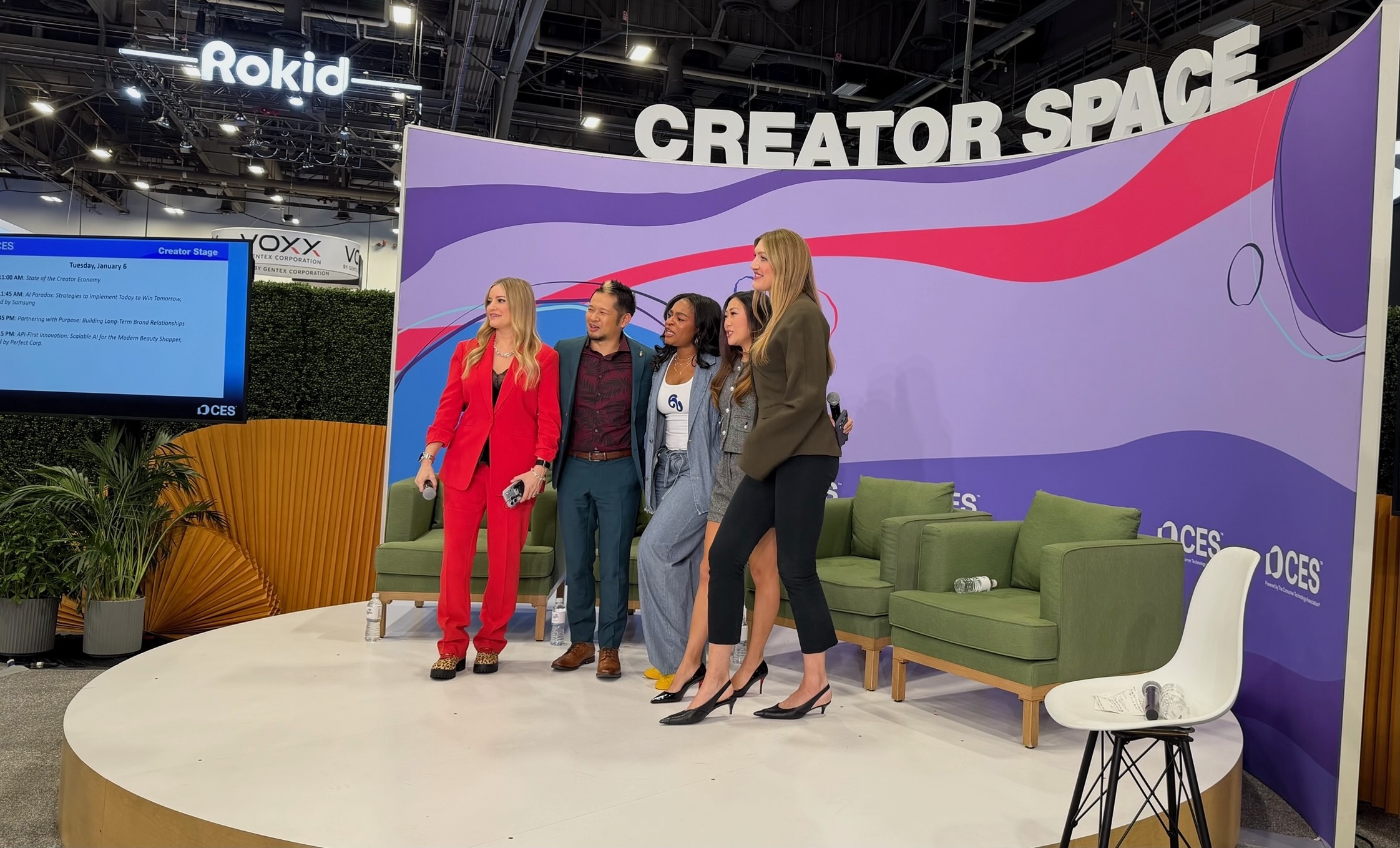
The Creator Space in the Central Hall at the Las Vegas Convention Center was easily twice the size of the space in 2025, and this time it was open to anyone attending the show, not just attendees with the badge. Popular Creators Justine Ezarik and Brian Tong are official hosts of CES and we got a chance to see them both on a panel when we visited the space, which was standing room only. There was programming all day and companies like Sony, Samsung, Shure, Rode and Small Rig featuring cameras, tools and software just for this market.

Our favorite part of CES was our smart home influencers meetup on Sunday before the event started. This year we had two sponsors, Zooz and the Open Home Foundation and we hit capacity on our room. We have really loved getting to know our fellow creators in this space and love getting a chance to hang out with them in person.
Summary
CES 2026 is in the books and we’re already thinking about what we’ll do next year. In the meantime, we already have lots of new products to review! Stay tuned to find out what’s new.