
Amsterdam Revisited: Why Our Pre-Cruise Stop Became Our Favorite Visit Yet
We’ve both been to Amsterdam multiple times, but neither one of us really took to the place. Personally this was my sixth time in the city and definitely my favorite.
We stopped briefly last year on an ocean cruise and intended to visit the Van Gogh museum. The cruise tour price seemed unusually high, so I booked our tickets online and figured we could easily get to and from the museum by ourselves.
That turned out to be a gross miscalculation – we wound up docking about an hour from the city and logistically it was just too hard to get to the museum and back to the ship before our early evening departure. I was disappointed and vowed to come back another time.
So when we had a chance to visit again before our European Sojourn cruise, we made sure to come in a couple of days early. We booked a hotel in the museum quarter and were so glad we did.
Arriving in the city
Upon arrival we took a car to Hotel JL No76, a boutique hotel just off the museum square. It’s on a very quiet street that feels residential, unlike the other places I’ve stayed in Amsterdam.

Since our flight arrived early in the morning we had to wait a little while before our room was ready. We left our bags and wandered around a bit before we gave up and came back to sit in the comfy hotel lobby. We ran into a sweet couple from the states who were also stopping over on their way to a Viking cruise and they told us about their trip and shared some great restaurant recommendations.
Once we checked in, we noticed a flyer in the elevator talking about Remembrance Day, letting us know that at 8 p.m. there would be an official country-wide two minutes of silence. We asked at the front desk about it and the clerk told us that there would be a ceremony later on in the evening in Dam Square so we decided to check it out.

In the meantime we enjoyed a late lunch at the Burger Room around the corner from our hotel. At first I eschewed the idea of a burger for our first meal in Amsterdam, but I’m glad we did. The burgers were delicious and the place was fun – with elaborate decor inspired by the Wizard of Oz.
Remembrance Day
Dam Square is in the center of the city and turned out to be a short walk from our hotel. We knew there would be a crowd but weren’t sure what to expect, so we got there a little before 7 p.m. to find a place in the crowd.
We wound up in a large group of people just opposite the National Monument on Dam Square. There were big screens set up broadcasting the entire ceremony, which started with a church service and several different speakers. We couldn’t really understand what was going on but enjoyed being a part of the crowd. There were people of all ages around us – a family right in front with grandparents, parents and grandkids, a group of twenty-somethings next to us who looked like they had just left the office, and people on balconies and tall buildings surrounding the square watching from above.

The Silence at Dam Square
Then the clock struck 8 p.m. and everyone fell silent for two minutes. It was very powerful. I’ve experienced moments of silence in the past, but something about two minutes just felt longer. I was impressed that everyone stayed silent – I didn’t even hear any babies fussing. My understanding is that this silence is observed all over the country – in stores, restaurants, hotels – people even pull their cars over and sit until it’s over.

Once the silence was over the ceremony resumed. There was a song, then a long procession of different wreaths laid at the National Monument in front of the King and Queen. The most moving scenes were when some older people came up to lay wreaths accompanied by their grandchildren. Even in a foreign language we recognized the significance of the current generations participating in the tradition and remembering the past.
Van Gogh Museum
The next day we had breakfast at our hotel then ambled across the street for our timed tickets for the Van Gogh museum. It was sold out when we arrived so I was glad I had pre-booked at home.
The museum has been open since 1973 and was made possible by Vincent’s sister in law Johanna van Gogh-Bonger, who championed his work after his early death, and Vincent’s nephew and namesake, Vincent Willem van Gogh.
The Legacy of Johanna van Gogh-Bonger
After Vincent died in 1890, closely followed by his dear brother Theo, Johanna inherited all of Vincent’s unsold work. She was responsible for promoting and selling his work, first in the Netherlands and then throughout the world and establishing his legacy. She maintained a personal collection that passed to her son, and he lent it to a museum in Amsterdam so the public could see it. He eventually created a foundation which still owns the paintings today.

The museum is in two parts, a 70s modernist design that holds the permanent collection and a separate exhibition space built in 1999 that’s connected to the original building by a tunnel. We started our visit in the separate space, visiting the current exhibition devoted to the color yellow. It was fun, with lots of different paintings featuring yellow including van Gogh’s famous sunflowers, and a section where you could smell different shades.

Then we made our way to the main collection with our audioguides. The collection is arranged chronologically and the narration walks you through Vincent’s short life, from his very earliest dark paintings of buildings and landscapes, to his first significant work, “The Potato Eaters,” a heavy dark picture of hard-working peasants lit by lamplight, painted before he moved from the Netherlands to Antwerp and Paris. It’s so different from all the works that made him famous.
A Journey Through Vincent’s Artistic Life
From there the audioguide and the paintings take you on a bittersweet journey of his artistic life. He had mental health struggles his whole life and had a difficult time supporting himself. He relied on his younger brother Theo financially and emotionally throughout those years and the museum displayed many of their letters side by side with the different paintings.

In Paris Vincent grew a lot artistically, especially influenced by the Impressionists and Post Impressionists and you could see that growth in his work. But the big city was too much for him so he eventually moved to Arles, in Provence, where he spent the rest of his life.
In Arles he was inspired by the bright sunlight and colors of the Provence landscape and had his most prolific period, often finishing a painting every day. You could also see the transition in his painting style through his many self-portraits.
The audioguide does a great job explaining the “incident” – in December 1888 when van Gogh cut off part of his ear after a disagreement with his friend Paul Gauguin. Shortly after that he was hospitalized in Arles, then later the next year he committed himself to an asylum in nearby Saint Remy de Provence where he produced some of his most famous paintings, including Starry Night.
While it seemed that Vincent was recovering after he was released from the asylum, he was obviously still troubled. In his last painting he was working on before his death, he was creating an abstract close up of some tree roots. They believe he worked on it in the morning then shot himself later that afternoon.
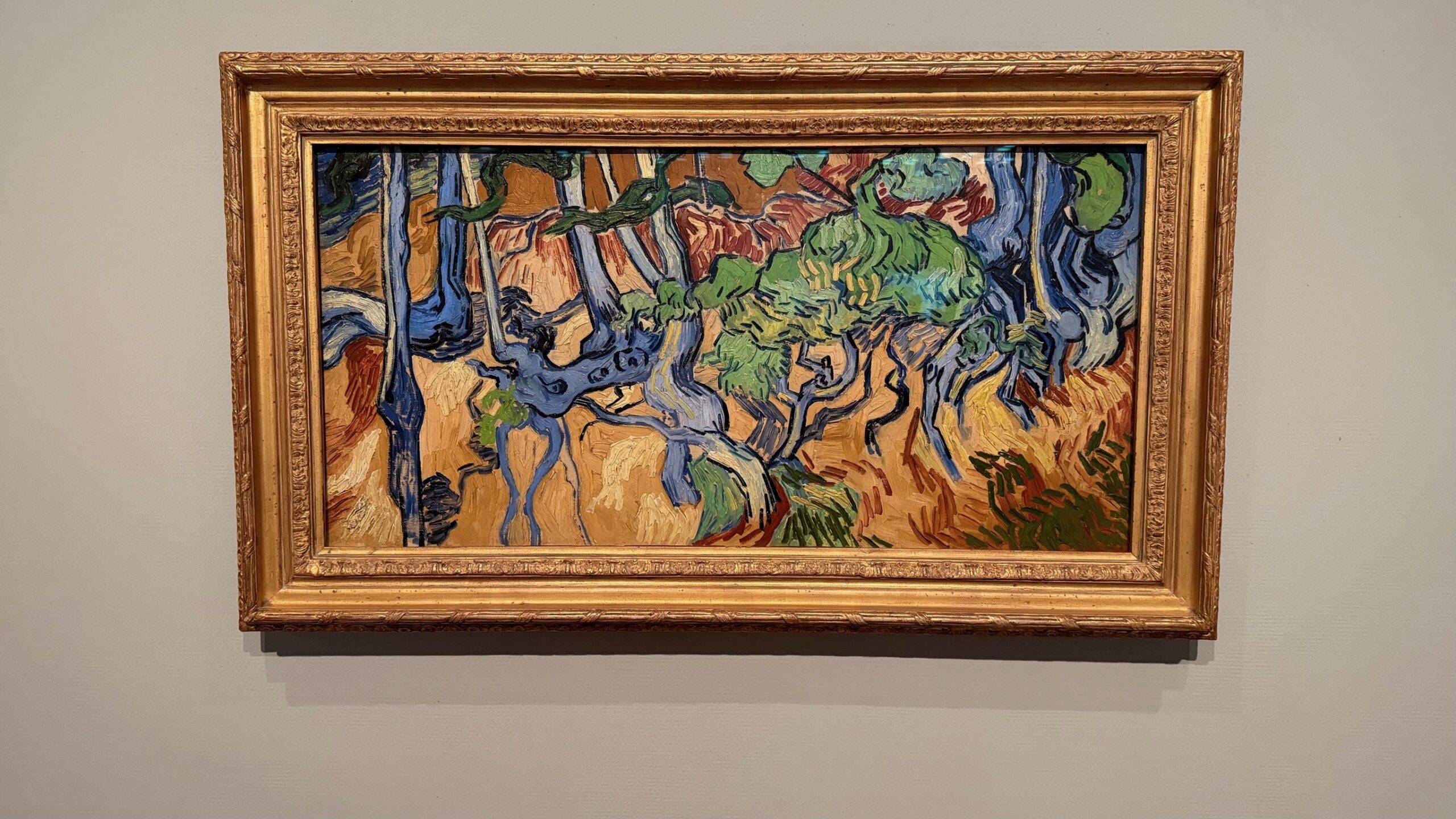
The museum was an amazing experience and I would recommend it to anyone with even the slightest interest in art. It’s very sad but so interesting to see how his artistic genius evolved, and to see how his family was able to establish his legacy after his death, that continues to attract global crowds to this day.
Liberation Day and the Rijksmuseum
We were visiting on Liberation Day, a national holiday celebrated with festivals all over Amsterdam and the rest of the country. There were some big outdoor festivals and concerts going on throughout the city, but in our more sedate museum quarter there was a small family-friendly festival focused on dance. There was a nice crowd of people, food trucks and a stage set up just outside the Rijksmuseum and we wandered around a bit. But it was too chilly for us so we escaped to a nearby cafe for lunch instead.

Inside the Rijksmuseum
After lunch we explored the Rijksmuseum, the national museum that has been in Amsterdam since 1885. In contrast to the Van Gogh museum it has thousands of paintings and other objects collected during the Dutch golden age, when they were some of the wealthiest traders in the world.
There are hundreds of works by Dutch masters but the most famous is Night Watch, a huge painting by Rembrant that has its own gallery. I had already seen it and couldn’t wait to share it with Mark. It was still there but is undergoing a comprehensive restoration project – so it was behind a protective glass chamber with scaffolding around it.

Since it was a holiday no one was actively restoring it, but they had people there who could answer questions about the process. They call it Operation Night Watch and it will take years to finish. Right now they are carefully removing the old varnish section by section.
The entire museum is massive and too much to see in just a couple of hours. We did enjoy seeing some of the other unique pieces, especially the library and the World War I era biplane tucked away on one of the upper floors.
Experiencing Indonesian Food
That evening we had a reservation at Sama Sebu, an Indonesian restaurant recommended to us by the couple we met on our first afternoon in our hotel. The Dutch colonized Indonesia for hundreds of years, and after the country gained their independence, many people migrated to the Netherlands and Amsterdam has a large established Indonesian community.
Sama Sebu in particular happens to be one of the more famous locations, established in 1969 and has been in the same family since. They claim to be the oldest Indonesian specialty restaurant in the Netherlands.
The restaurant had a lot of different dishes to choose from, but we decided to try the traditional rijsttafel (rice table), which at Sama Sebu is 18 different small plates that come out all together, covering the entire small table. It was a little overwhelming to be honest, but with a bit of direction from our waiter we were soon sampling all the different things and enjoying them.
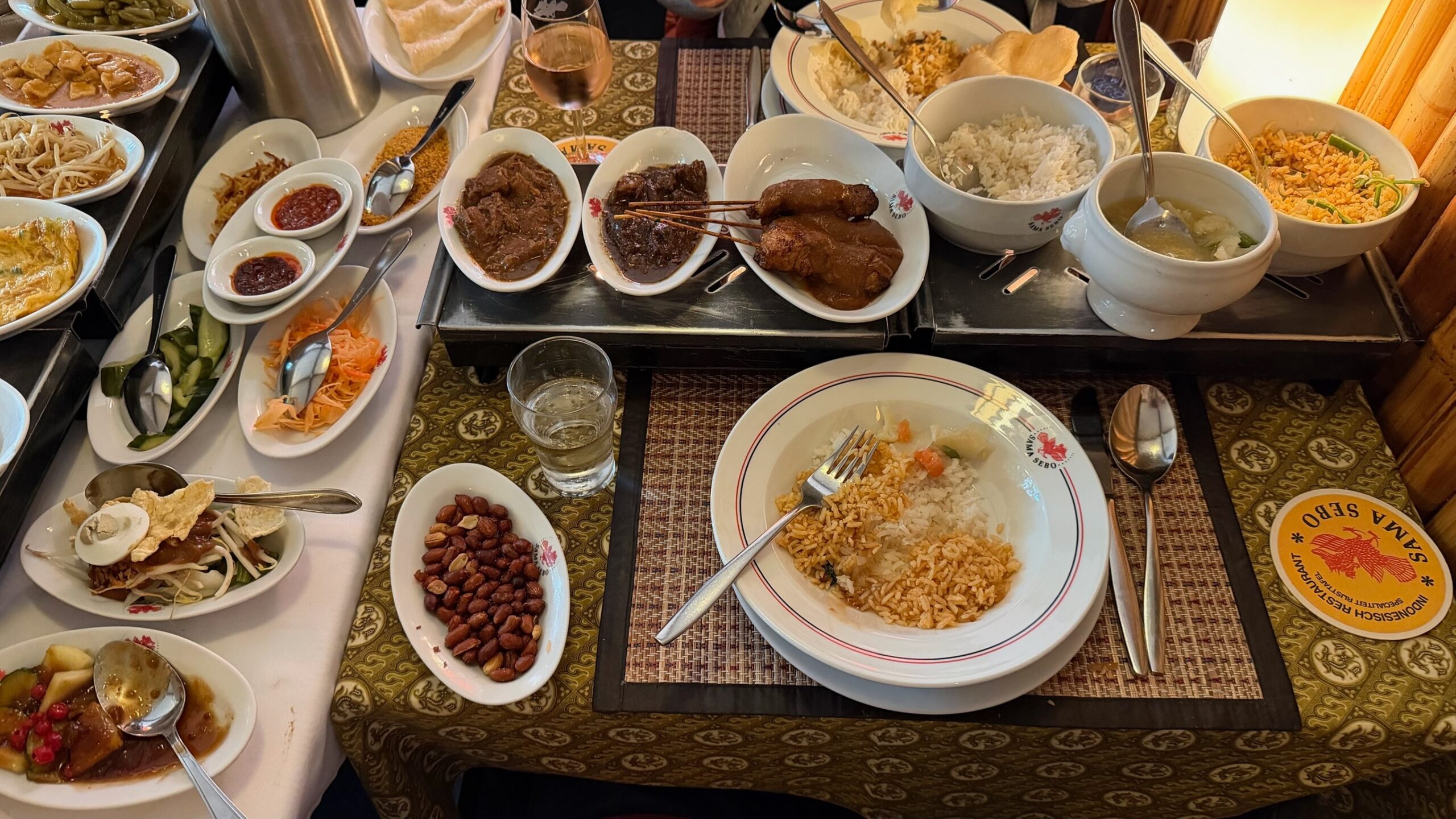
While everything served are Indonesian specialties, the rijsttafel is actually a uniquely Dutch tradition. During colonial times the wealthy Dutch hosts would serve their honored guests this way as a way to showcase the cuisine, and the Dutch and Indonesian people who moved back to the Netherlands brought the tradition back with them.
The restaurant was packed the night we visited and we had a great time, though we didn’t come close to finishing all those little dishes.
Boarding our ship and embarking on our cruise
The next day we checked out of our hotel and made our way to the river boat dock to board our ship for our Viking cruise.

Once we were on-board and settled, we took advantage of the guided walk to see another perspective of Amsterdam from the more modern, industrial side of the city. By the end of the evening, we were on our way from Amsterdam to enjoy the rest of our European Sojourn.
Summary
This was by far our favorite visit to Amsterdam. We especially enjoyed celebrating Remembrance Day and Liberation Day with the locals and exploring the museum quarter. We look forward to returning again in the future.